



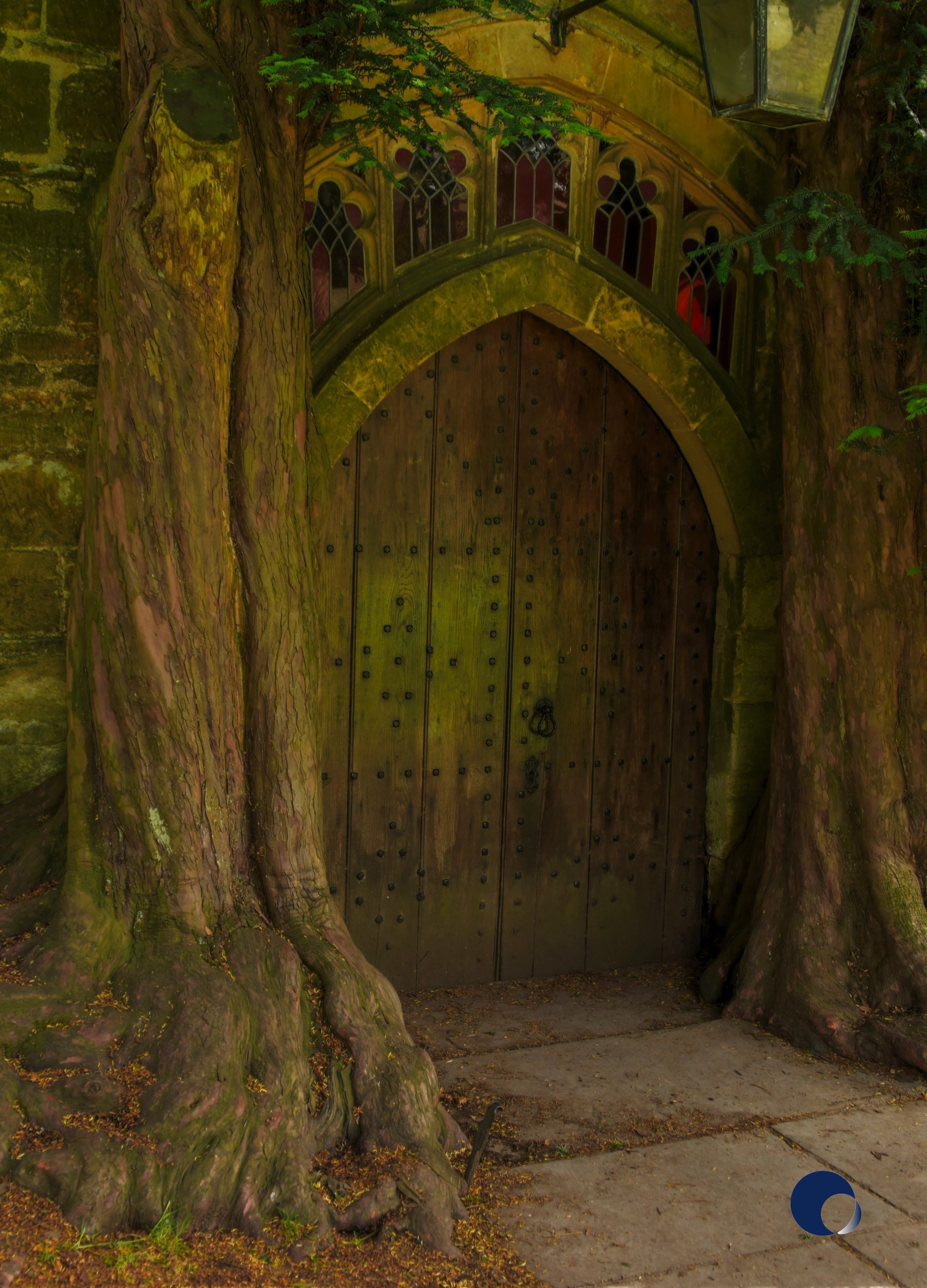
A Fairytale Threshold in the Heart of the Cotswolds
In the quintessential English region of the Cotswolds, famed for its honey-colored limestone villages and undulating green pastures, St Edward's Church in Stow-on-the-Wold appears from the street as a noble medieval parish sanctuary. Yet when visitors meander toward the secluded northern churchyard, they encounter an almost surreal tableau where rational human masonry and the patient, centuries-long will of nature merge into a singular entity: a 13th-century Early English Gothic archway flanked and embraced by two colossal, ancient yew trees (Taxus baccata).
Over three centuries, the thick, muscular trunks and gnarled roots of these trees have tightly fused with the oolitic limestone jambs of the doorway. The living timber and the sculpted ashlar have formed an indivisible hybrid organism. This is not a scene of destructive botanical invasion, but rather a sublime architectural symbiosis where nature and human craft stand together in serene, eternal equilibrium.
The Portal That Inspired Tolkien’s Legendary Gates of Durin
The worldwide fascination with this enchanting gateway is deeply intertwined with literary legend. During his tenure as a professor of Anglo-Saxon and linguistics at Oxford University, J.R.R. Tolkien frequently wandered through the surrounding Cotswold hills, often pausing at Stow-on-the-Wold.
In *The Lord of the Rings*, the clandestine western portal of the ancient dwarven realm of Khazad-dûm—the famed "Doors of Durin" (or the West-gate of Moria)—is described as an ancient stone arch flanked by two towering, guardian trees whose roots entwine the threshold, opening only to those who speak the word of friendship. Tolkien transformed this humble Cotswold church portal into one of the most celebrated and indelible thresholds in world fantasy literature.

“St Edward’s Church Portal reveals that the boundary between masonry and botany is never absolute; approached with generational patience and reverence, living roots do not tear stone apart—they anchor it to eternity.”
Iconography of the Yew Tree and Botanical Time
In ancient Celtic cosmology and European folklore, the yew tree is the ultimate symbol of immortality, resurrection, and the boundary between physical life and eternity. Because yew trees possess the rare biological capability of rooting interior trunk decay while regenerating fresh outer trunks, individual specimens can thrive for millennia—prompting their presence in holy precincts long before Christian churches arose.
Planted around 1700 at the threshold of St Edward’s northern portal, these twin saplings grew not as destructive forces, but as loving sentinels shielding the medieval sanctuary. As their fibrous wood settled into the microscopic pores of the Cotswold stone, the building's deep foundations provided the trees with unwavering stability against howling Cotswold gales.

Biodesign and the Future of Organic Architecture
In contemporary architectural discourse, nature is too often treated as a liability—an external force to be sealed out, sterilized, or rigidly partitioned. St Edward’s portal presents an inspiring counterpoint, proving how botanical growth and structural construction can weave a single poetic narrative. The heavy oak door and wrought-iron hinges have adapted organically to the gentle pressure of the expanding trunks over hundreds of years.
For modern landscape architects and biophilic designers, this historic portal serves as a profound case study. The principles of structural adaptability and botanical-structural integration that we admire today in living root bridges or biodiverse green facades have been flourishing quietly at this English parish church for over three centuries.
A Living Monument at the Threshold of Time
The yew-framed portal of St Edward's Church stands as a timeless architectural sermon: architecture is not merely about stacking inert blocks against the elements, but about embracing time, soil, and the breath of the living earth to achieve authentic immortality.
Content: Moon Content Team
