



It is possible to say that cities are composed of different contextual layers, which overlap, stand side by side, and at times intertwine, forming their unique modes of existence. In the case of Yalova, however, striking contrasts between the main layers specific to the city draw attention. On one hand, Yalova is a city of nature—home to endemic plants, as well as areas where these are carefully cultivated, displayed, and commercially utilized by human effort. Moreover, one of the most advanced arboretums in the region is a significant element shaping the city’s identity. A colorful, lively, and vibrant world comes to the forefront here, carrying a sense of positivity and even a resort-like atmosphere where life feels pleasant and trouble-free.
At the same time, Yalova is also an industrial city. Undoubtedly, the mode of existence shaped by this aspect is not as effortless as the other. It can hardly be described as cheerful or vibrant; instead, it speaks of the more demanding aspects of life—labor, effort, and sweat. Compared to the former, this is a more subdued and challenging world.
Leaving aside the question of which is more authentic, it would not be wrong to say that these two entirely contrasting modes of existence coexist within the city, nourish one another, and that the tension created by this opposition shapes the city’s unique spirit. As a ‘cultural center,’ the way in which the building establishes a relationship with this spirit of the city and its inhabitants emerges as the main driving force of the design. In this context, the center aims to form a mediated relationship with the city’s contrasting layers.
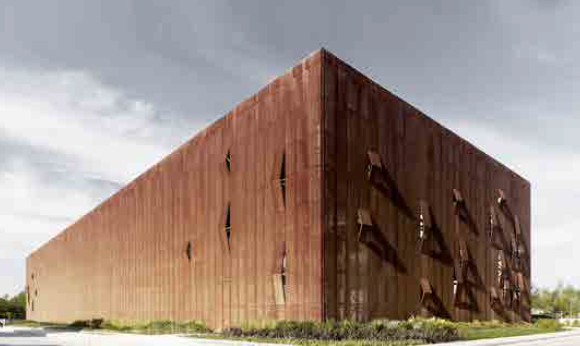
The building is positioned toward the western edge of the site, allowing space in front for an urban garden. In its external perception, it avoids the familiar, glittering, and dominant monumental language of contemporary cultural centers. In fact, it deliberately distances itself from this colorful, carefree yet imposing world. In doing so, the ‘designed’ does not attempt to instruct or discipline the ‘user.’ Instead, the design largely embraces a sense of openness.
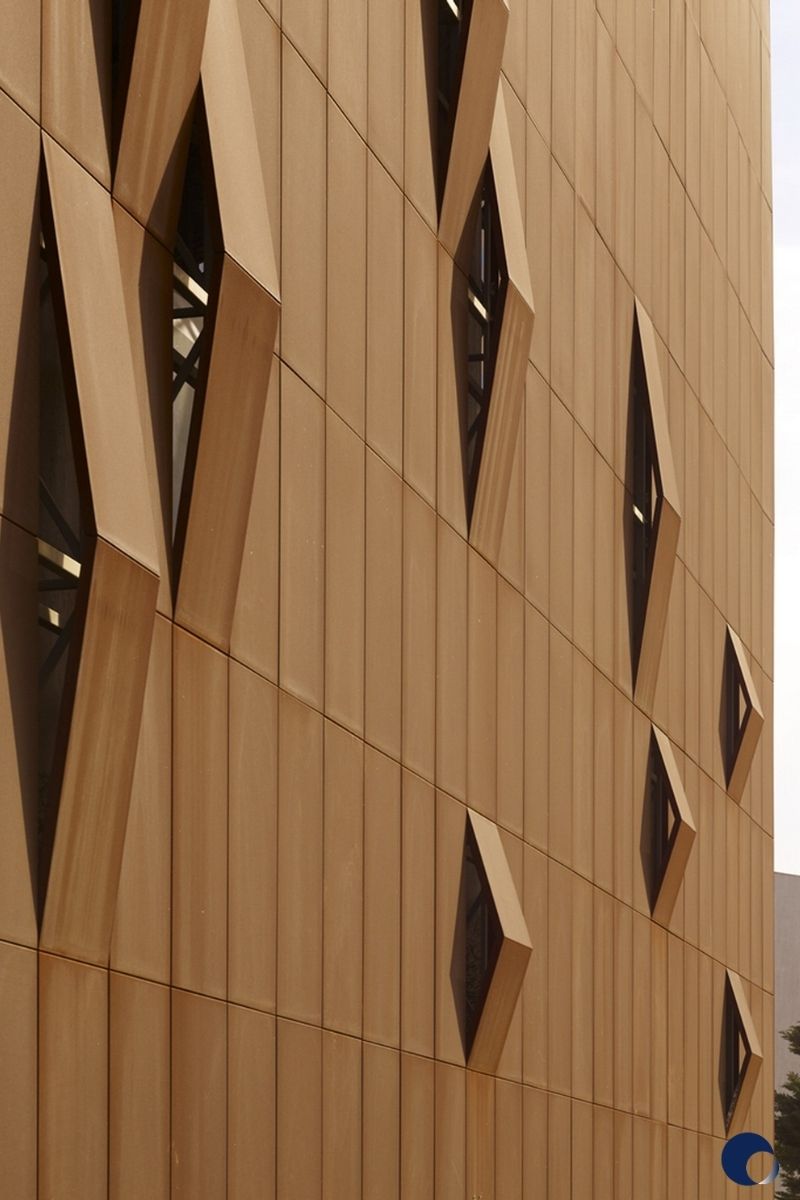
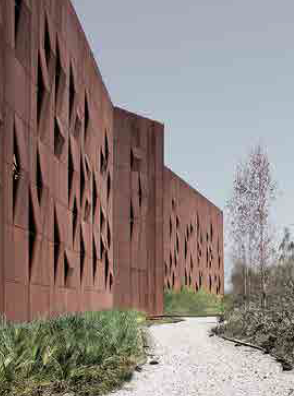
At first glance, the structure does not reference any particular form. This mass, resembling almost ‘nothing,’ creates a sense of neutrality that gradually shifts toward the industrial spirit of the city as one approaches. Instead of glossy and assertive materials, the façade is clad with perforated panels made of weathering steel (Corten A), whose rusted surfaces reinforce this impression. Although not previously used in such a building, this texture is familiar to the city’s inhabitants from industrial environments, allowing them to easily recognize and relate to it. The building thus sheds its ‘newness’ and sense of unfamiliarity, taking an important step toward becoming integrated with the city and its people.
The perforated façade allows the surface to dissolve in the evening, much like a sheer curtain, making the ‘interior world’ easily perceptible. Users enter the building through a large opening, without doors or barriers. Here, the metal mesh acts as a protective layer, shielding against wind, rain, and harsh sunlight while maintaining a semi-permeable character that prevents the space from becoming a fully enclosed interior. Natural air circulates freely within this intermediate zone.
The volumes within the building are shaped according to their functions and required dimensions. Spaces such as a 600-seat multipurpose hall, a 150-seat seminar room, wedding and exhibition halls, a library, offices, and a cafeteria are connected across different levels. While these volumes exist independently from the exterior and from each other with their own distinct geometries, their surfaces reference Yalova’s rich and colorful natural texture. The intention is for digitally printed surfaces depicting various plant species in vivid colors to create a ‘cheerful’ appearance, visible not only at close range but also as a secondary layer behind the façade.
The ‘circulation ramp’ connecting these volumes acts as a sheltered inner street, aiming to enrich the visitor’s daily experience. The voids between the volumes accommodate recreational functions and auxiliary service areas.
Content: Tasarım Group
